
Skin Journaling: The Clinic Tool That Improves Skincare Results
Most skincare routines fail not because of the wrong products, but because of the wrong information. Without tracking what you're applying, when, and how your skin responds, you're essentially changing variables blindly and hoping for a result. Skin journaling is how Korean clinics and their clients change that equation.
Before we dive in, a note on honesty: skin journaling is a documentation practice, not a clinically validated standalone intervention, and it does not replace professional dermatological assessment. If you have persistent skin concerns, consult a dermatologist or GP. What the research does support is that self-monitoring and consistent tracking can meaningfully improve adherence to treatment and in skincare, consistency is everything.
What Is Skin Journaling, and Why Do Clinics Use It?
Skin journaling is the practice of regularly recording observations about your skin texture, hydration levels, breakouts, redness, reactions to products, and environmental factors like weather or stress. Patient self-monitoring is a practice used in dermatology clinics worldwide, including Korean clinics, to support treatment adherence. It fits naturally into the Korean skincare philosophy, which places emphasis on the process of skincare, not just the products: encouraging mindfulness, patience, and a deeper understanding of your own skin.
In clinical settings, documentation of patient skin status is standard practice in dermatology globally. What makes the Korean clinic approach notable is the emphasis on client-side tracking between appointments giving practitioners richer, more contextual data when clients return for follow-up.
What Does the Evidence Actually Say?
Let's be upfront: there are no peer-reviewed studies validating "skin journaling" as a uniquely Korean clinical method with proven superior outcomes. What does exist in the broader dermatology and health psychology literature is worth understanding:
- Patient adherence tracking may improve treatment results. Research suggests that self-monitoring diaries can correlate with improved compliance in acne treatment, with patients who use structured tracking tools tending to show better adherence rates than those without.
- Visual documentation supports objective assessment. The American Academy of Dermatology and the British Journal of Dermatology (2019) both support standardised photography protocols for tracking changes in erythema, pigmentation, and skin texture over time reducing observer bias and providing a reliable baseline.
- Behavioural tracking may boost motivation. A meta-analysis in Health Psychology Review (2016) found that self-monitoring health behaviours was associated with improved adherence to health regimens. While this isn't specific to skincare, the principle translates: when you track something, you tend to stick with it.
The takeaway? Skin journaling is a clinically sensible habit, even if the evidence base is still emerging and is drawn from general self-monitoring research rather than K-beauty-specific studies.
What to Track in Your Skin Journal
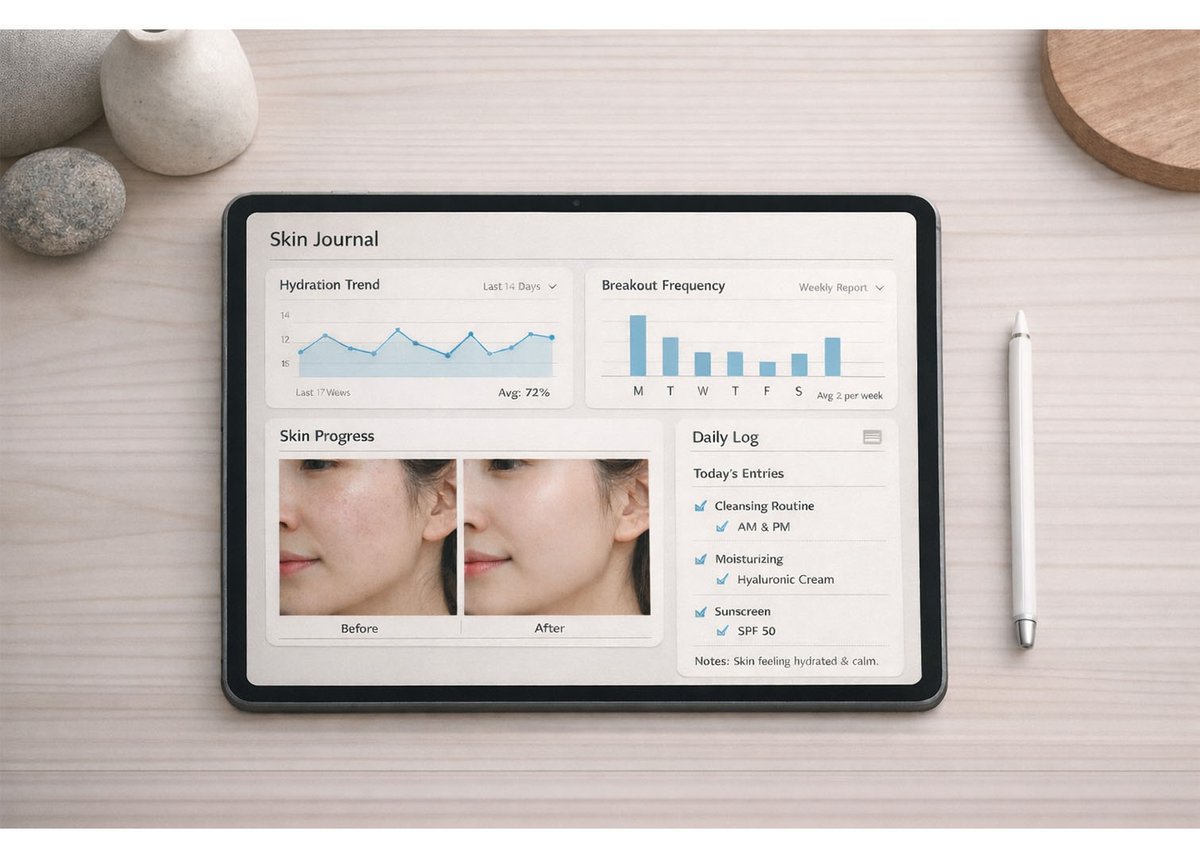
A useful skin journal doesn't need to be elaborate. Here's what Korean clinic practitioners commonly recommend documenting:
Daily Observations
- Hydration levels: Does your skin feel tight, balanced, or oily? Self-reported hydration is subjective, but tracking patterns over weeks can reveal meaningful trends.
- Breakouts and blemishes: Note location, size, and whether they're forming or healing. This is especially useful if you're using active ingredients like salicylic acid or niacinamide.
- Redness and sensitivity: Redness that appears consistently after certain products or environmental triggers is a signal worth capturing.
Weekly Check-Ins
- Progress photos: Take photos in consistent lighting (ideally natural, indirect light) at the same angle each week. This removes the bias of memory and gives you and your clinician an objective record.
- Product reactions: Note any new products introduced and how your skin responded over 48–72 hours. Korean clinics often recommend multi-step routines, and tracking ingredient reactions helps identify what's working and what isn't.
Seasonal and Environmental Notes
- Dermatology literature confirms that acne, rosacea, and eczema all show seasonal variation (Helm et al., 2013, Dermatology). In Australia, where UV exposure is intense year-round and humidity varies significantly by region, noting environmental factors alongside your skin's behaviour can help you and your clinician anticipate flares before they happen.
How Skin Journaling Supports Barrier-Focused Treatments
One of the pillars of Korean clinic skincare is barrier health the idea that a well-functioning skin barrier is the foundation of every other skin goal, from acne management to anti-ageing. Journaling your skin's hydration and sensitivity levels over time may help you identify patterns in your skin's behaviour such as recurring tightness, flaking, or reactivity that are worth discussing with a clinician.
Research into skin barrier function (Proksch et al., Clinics in Dermatology, 2008) highlights that symptoms like tightness and sensitivity can reflect changes in transepidermal water loss (TEWL) and barrier integrity. While TEWL measurement requires clinic-grade equipment, tracking how your skin feels day to day gives you meaningful observational data to bring to your next appointment. Your journal becomes a conversation starter, not a diagnosis tool.
This is particularly relevant in Australia's variable climate. Whether you're in humid Brisbane or dry-season Darwin, your barrier behaves differently across seasons and a consistent journaling habit helps you connect those environmental dots over time.
Getting Started: A Simple Skin Journaling Template
You don't need a dedicated app or a fancy notebook. A notes app on your phone works just as well. Here's a simple daily entry structure:
Date:
Morning skin feel (1–5, dry to oily):
Products used (AM/PM):
Any new products introduced:
Breakouts or blemishes (location, stage):
Redness or sensitivity (yes/no — where?):
Environmental notes (weather, stress, diet):
Weekly photo taken (yes/no):
Review your entries weekly. After four to six weeks, patterns tend to emerge and those patterns are exactly what a Korean clinic practitioner (or your local dermatologist) can work with.
Conclusion
Skin journaling won't transform your skin overnight, and it isn't a substitute for professional advice. What it is is a low-cost, low-effort habit that puts you in the driver's seat of your own skincare journey. By documenting what you observe consistently and honestly you create a feedback loop that makes every clinic visit, every product switch, and every routine adjustment more informed.
If you're already investing in a Korean skincare routine, adding a five-minute daily journal entry is one of the simplest ways to make that investment work harder.